

When Lenin died in 1924, the party was thrown into a power struggle began. With his position secure, Stalin focused on consolidating his power and promoting antagonisms among party leaders.
:format(jpg)/f.elconfidencial.com%2Foriginal%2F7ac%2Ff2f%2F638%2F7acf2f638c190b73c7bf513f8d33b8d6.jpg)
Stalin opposed Trotsky in the Soviet Communist Party. Stalin’s theory of “Socialism in one Country” was a contrast to Trotsky’s “Permanent Revolution” to extend revolution in other countries. Stalin defeated his opponents within the party by 1928, ending internal power struggles. From 1929 onwards Stalin’s leadership over the party and state was established and he remained undisputed leader of the USSR until his death.
Stalin’s government had the following characteristics:
Stalin wanted to turn the USSR into a great industrial power, for which he prohibited private property: land, factories and transportation were property of the State. He encouraged heavy industry to build infrastructure.

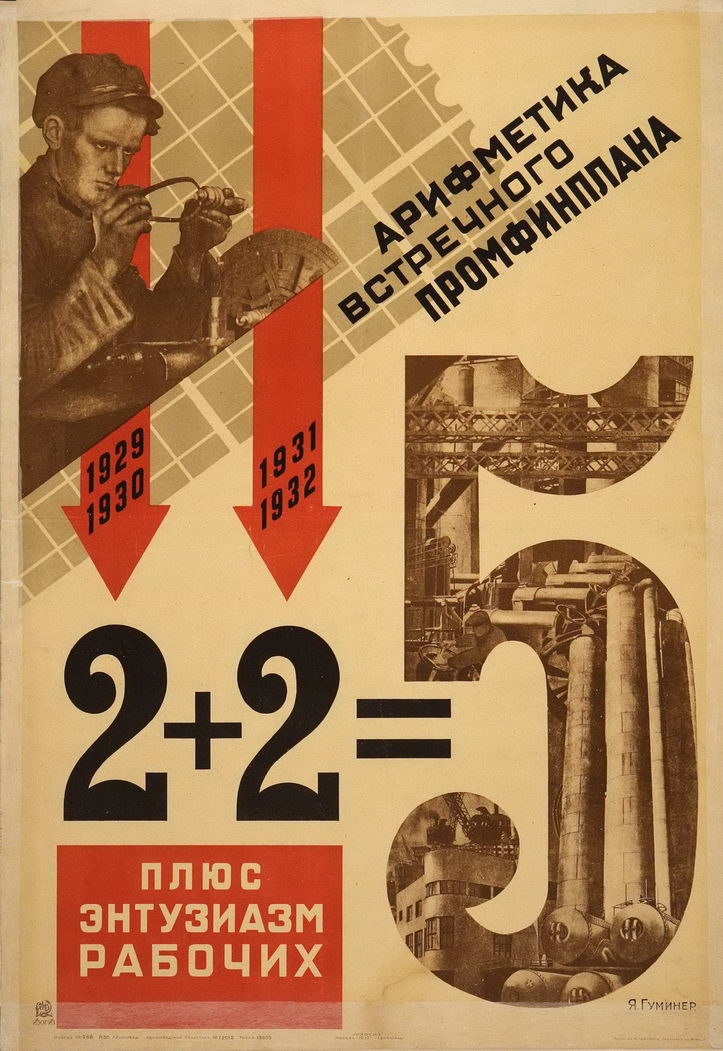
– The State planned the country’s economy: through five-year plans (renewed every five years) objectives were established for agricultural and industrial production, which allowed rapid industrialization of the USSR. An official body, Gosplan, set the objectives and evaluated the results.
-the prohibition of private property. Land, factories, banks and transport became state property.
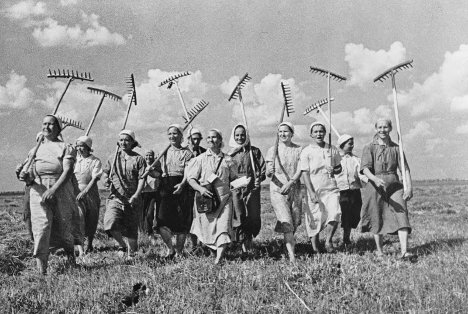
Forced collectivization of agriculture, which led to tension in the countryside. Collective properties were organized into two types: the kolkhoz, which was a cooperative managed by peasants, and the sovkhoz, which was a state-owned farm.

Industrial development based on heavy industry. The result was rapid industrialization, but agriculture development was delayed. The production of consumer goods was neglected, and the needs of the population were ignored.

– Political persecutions: Stalin was a dictator who persecuted his political enemies and repressed the population with executions, imprisonment or deportations to forced labor camps (Gulag).

State and depended on the will of Stalin.
Membership in the party was essential to occupy any position of responsibility and communist ideology was imposed on the entire society. To consolidate his personal power, Stalin spread terror throughout the country and carried out harsh repression: anyone suspected of opposing Stalin was accused of being an “enemy of socialism.” In 1929, the gulag was instituted, a network of prison camps where opponents of the regime were held and forced to perform forced labor.
The 1936 Constitution defined the USSR as a socialist state of workers and peasants. It was based on workers’ representation in the soviets (councils). The highest council was the Supreme Soviet, which had two.

The Constitution officially recognized different nationalities, universal suffrage, division of powers and citizen rights, but this was not real. Rights and freedoms were non-existent, and the control of all state institutions by the CPSU was absolute.
Stalin had absolute control over the main state institutions and prioritized central Soviet power over regional nationalities. The USSR became a police state that used violence to repress dissent and maintain the power of Stalin and the nomenklatura.

POWERPOINT PRESENTATION ON THE TOPIC:
NOTES READY TO STUDY:
WORKSHEETS TO PRACTICE:
5_Collectivisation_Conclusion_STUDENT
VIDEOS TO REVIEW:
 4 TRAVELLING ACROSS TIME